The Learjet 60 Reckoning: Retrofit or Retire Ahead of 2027 Mandates
Rising maintenance costs, scarce CRT parts, and 2027 airspace mandates are forcing Learjet 60 owners to choose between million-dollar upgrades or retirement.


For decades, the Learjet 60 was the darling of the midsize business jet market. It climbed fast, cruised efficiently at high altitudes, and carried the legendary brand name with pride. Private pilots loved its sports-car handling. Charter companies prized its transcontinental range. For a long time, it was a reliable workhorse of corporate aviation.
But today, owners of these iconic twinjets are staring down a financial cliff. A perfect storm of obsolete cockpit screens, looming airspace deadlines, and engine overhaul bills is forcing a difficult choice. Operators must either invest millions of dollars into their aging airframes or send them to the scrap yard. For many, the decision is already made.
The CRT Crisis and the Death of Pro Line 4 Avionics
At the heart of the Learjet 60 crisis is the cockpit. Most of these aircraft, manufactured between 1993 and 2012, rely on the Collins Aerospace Pro Line 4 avionics system. This system uses heavy, power-hungry cathode-ray tube (CRT) displays. The problem is simple: nobody makes CRTs anymore.
As these vintage glass screens fail, finding replacements has become a high-stakes scavenger hunt. Operators are scouring salvage yards and secondary markets for working displays. Collins Aerospace has warned that support for these legacy units is winding down. Repairs are getting more expensive, and lead times are stretching from days to months. If a single display dies and cannot be replaced, the entire aircraft is grounded.
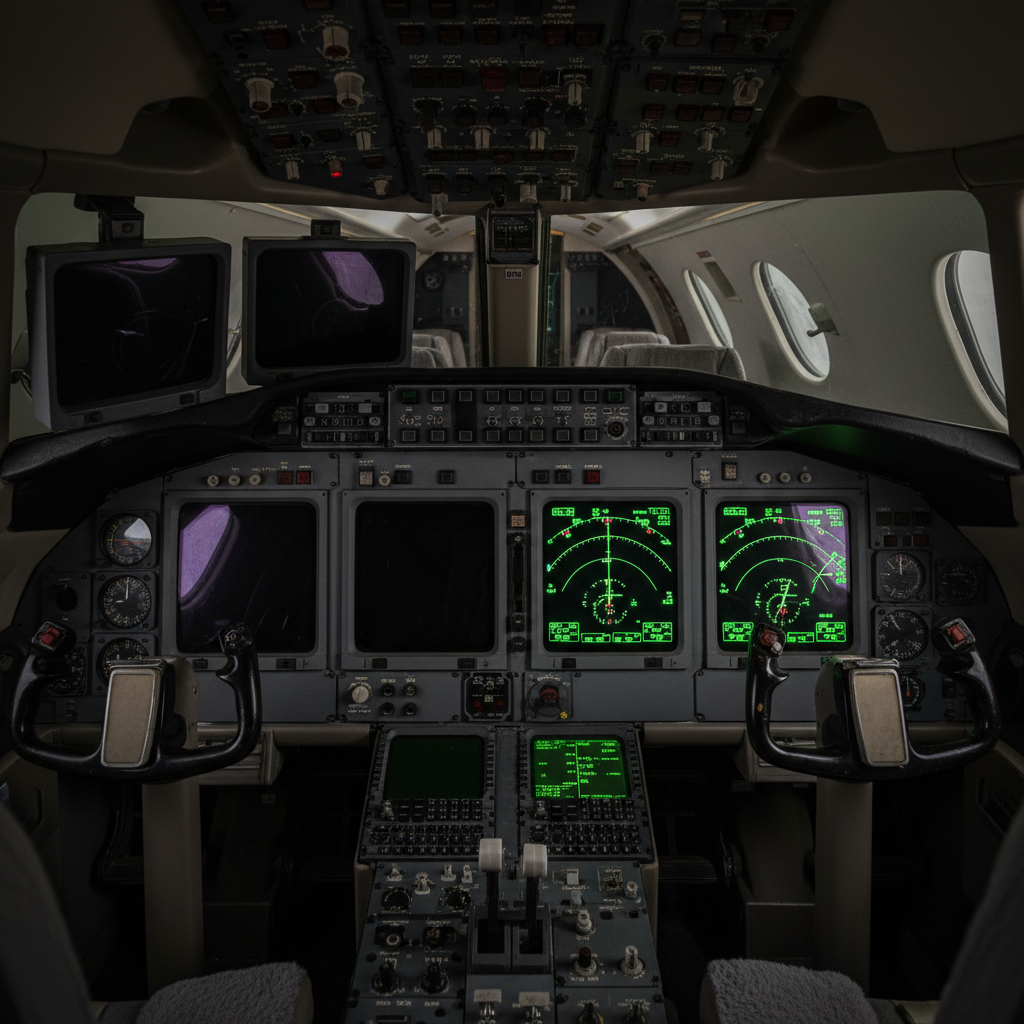
To keep flying, operators must swap the old systems for modern digital displays. Upgrades like the Garmin G5000 flight deck offer a brilliant, modern solution. They replace heavy wiring and outdated instruments with lightweight, touch-screen displays. But this upgrade comes with a massive price tag. A typical cockpit retrofit can easily cost between $500,000 and $700,000. For an aircraft with a declining market value, that is a hard pill to swallow.
The 2027 Airspace Mandate Cliff
Even if an owner is willing to tolerate temperamental cockpit screens, the clock is ticking. Regulatory authorities in both North America and Europe are tightening airspace requirements. By 2027, new mandates for digital communications and tracking will make un-upgraded aircraft functionally obsolete in key corridors.
The primary hurdle is the push for Controller-Pilot Data Link Communications (CPDLC) and modern surveillance capabilities. In Europe, the Link 2000+ mandate requires aircraft to use digital text-based messaging instead of traditional radio voice channels for routine ATC commands. In the United States, the FAA continues to expand its NextGen program, pushing more traffic into high-altitude tracks that require advanced data link capabilities.
Without these upgrades, a Learjet 60 will be barred from flying at the most efficient altitudes. This forces the jet into lower, more crowded flight levels where fuel burn is significantly higher. For a midsize jet built to fly at 41,000 feet and above, being trapped in the mid-20s ruins its economic viability. Retrofitting the legacy avionics to support CPDLC and modern FANS 1/A+ protocols adds another layer of cost to an already expensive upgrade.

The Brutal Math of Engine Overhauls
Avionics are only half the battle. The Learjet 60 is powered by Pratt & Whitney Canada PW305A turbofans. These are reliable, powerful engines, but keeping them running requires serious capital. The engines are subject to strict maintenance intervals, specifically the Major Periodic Inspection (MPI) and the Compressor Zone Inspection (CZI).</p
A CZI, which occurs every 7,200 hours, is essentially a complete engine teardown. In today’s market, performing a CZI on a single PW305A engine can easily exceed $1 million. Since the Learjet 60 is a twin-engine aircraft, a full engine maintenance cycle can top $2 million. </p
Now, consider the valuation of the aircraft. A late-1990s Learjet 60 in decent condition might have a market value of $1.2 million to $1.6 million. If that aircraft needs a double engine overhaul and a cockpit retrofit to comply with the 2027 mandates, the total bill could top $2.7 million. The maintenance cost is double the value of the entire airplane. This is what the aviation industry calls being ‘economically totaled.’
To Retrofit or to Part Out?
This harsh economic reality is splitting the Learjet 60 fleet into two distinct camps. Fleet operators who rely heavily on these aircraft for specific, high-utilization routes are occasionally opting for the retrofit. They argue that a refurbished Learjet 60, equipped with a brand-new Garmin G5000 deck and fresh engines, is still cheaper than buying a brand-new midsize jet for $15 million. To them, the upgrade gives the airframe another fifteen years of productive life.
But for the private owner or the small-scale charter operator, the numbers simply do not add up. A growing number of Learjet 60s are being retired early. They are not being retired because they are unsafe or worn out; they are being retired because they are financially unviable.
Salvage yards are seeing an influx of these aircraft. Mechanics are parting them out, stripping them of their engines, landing gear, and cabin components to keep the remaining active fleet flying. It is a quiet, unsentimental end for one of Bombardier’s most successful midsize designs. As the 2027 deadline draws closer, the trickle of retirements is expected to turn into a flood, marking the end of an era for classic business aviation.