Michigan Senate Race Tied in Final Polls Before Midterms
Final Michigan Senate polls show a dead heat just three days before the 2026 midterms, with independent voters in Macomb and Kent counties holding the key.

A Race Frozen in Place
There are only three days left. The campaign buses are running on fumes, the television airwaves are choked with negative ads, and yet, nobody can say who is going to win Michigan’s crucial U.S. Senate race. The final sprint has arrived, but the candidates are running in place.
The latest round of polling shows a literal dead heat. Two major surveys released Friday morning show the candidates locked in a margin-of-error tie, leaving the entire contest in the hands of a dwindling sliver of undecided voters. The Glengariff Group’s final survey of 600 likely voters has the race tied at 46% to 46%. Another poll, conducted by EPIC-MRA, shows a similar 47% to 47% deadlock. In both surveys, the number of voters who say they are still undecided has shrunk to just 5%. That tiny window of voters is concentrated heavily in two places: Macomb County, just north of Detroit, and Kent County, the powerhouse of West Michigan.
The Blue-Collar Battleground of Macomb
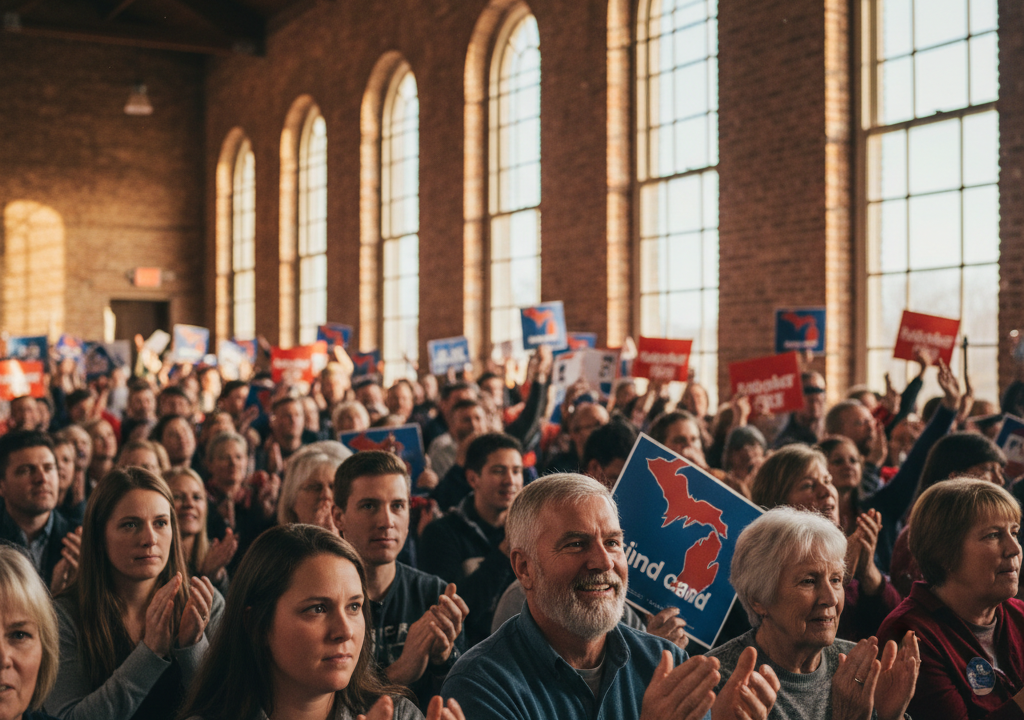
For decades, Macomb County has been the home of the ‘Reagan Democrat’—blue-collar, fiercely independent, and highly skeptical of political promises. It is a county where yard signs often tell a conflicting story, with neighbors split cleanly down the middle. This year, the focus is intense.
‘I change my mind every time I turn on the television,’ said Marcus Vance, an automotive machinist from Warren. ‘One day I think we need a change because gas and groceries are still too high. The next day, I worry about what a change would do to our local manufacturing jobs. It’s a coin toss right now.’
Vance is exactly the kind of voter the campaigns are spending millions of dollars to reach in these final hours. Both candidates have scheduled multiple stops in the county this weekend, targeting union halls and local diners. In Macomb, the debate over the transition to electric vehicles is deeply personal. Many families have at least one member working in a plant that builds internal combustion engines or components for them. The transition feels like an immediate threat to their livelihood, even as Democrats argue it secures the state’s place as a global automotive hub.

The Shifting Suburbs of Kent County
Meanwhile, on the other side of the state, Kent County presents a very different kind of political puzzle. Traditionally a bastion of conservative values, the Grand Rapids area has grown younger, more diverse, and increasingly moderate over the last decade. It has become a must-win battleground for any statewide campaign.
Political strategists say the shifting demographics in the Grand Rapids suburbs have created a pool of highly educated, fiscally conservative independents who are deeply uncomfortable with partisan extremes. They care about different things than the voters in the east.
‘I’ve voted for both parties in the past,’ said Sarah Lin, a software engineer living in East Grand Rapids. ‘For me, it’s about stability. I want someone who will go to Washington and actually get things done, not just scream on cable news. I’m waiting until Sunday night to make my final decision.’
Two Contrasting Campaigns
The campaigns are responding to these local pressures with a frantic, cross-state sprint. Democratic incumbent Gary Peters has focused his message heavily on protecting manufacturing jobs and expanding federal investments in clean energy. Over the last month, his campaign has relied on a massive ground game, knocking on doors in Detroit, Flint, and Grand Rapids to ensure high turnout among the party’s base.
On the other side, Republican challenger Mike Rogers has pounded the pavement with a message focused squarely on the economy. Rogers has hammered Peters on inflation and the high cost of living, arguing that the current administration’s policies have hurt Michigan families. His campaign has also run aggressive ads criticizing federal electric vehicle mandates, an issue that resonates deeply in auto-dependent communities.

The key issues driving voters to the polls this year include:
- The high cost of groceries and energy bills
- The pace of the transition to electric vehicles in local auto plants
- Protecting reproductive rights and healthcare access
- Border security and federal spending
The National Stakes
The stakes could not be higher. Michigan is widely seen as a must-win state for both parties as they fight for control of the U.S. Senate. With several other key races across the country also polling within the margin of error, the outcome in the Great Lakes State could decide which party holds the majority next January.
Ground operations have reached a fever pitch. In Kent County, the local Republican headquarters in Grand Rapids is a hive of activity, with volunteers making thousands of phone calls a day to independent households. Meanwhile, the Democratic coordinated campaign has set up temporary offices in strip malls across Macomb County, focusing on high-traffic areas to register last-minute voters and hand out literature.
Historically, late-deciding voters tend to break toward the challenger when economic anxiety is high. But political analysts warn that traditional rules might not apply this time. The deep polarization of the electorate means that even ‘independent’ voters often have a strong, albeit quiet, partisan lean.
As the hours tick down, the airwaves are saturated. In the Detroit and Grand Rapids television markets, it is almost impossible to watch a commercial break without seeing back-to-back campaign ads. Yet, despite the noise, the race remains stubbornly quiet at the center. The noise of the campaign has failed to drown out the quiet deliberation of the state’s undecided middle. For voters like Vance and Lin, the decision is not about party loyalty. It is about a gut check on where the country is heading. And with only three days left, Michigan is waiting on their answer.